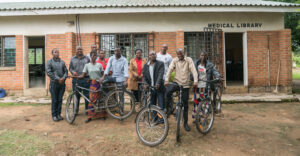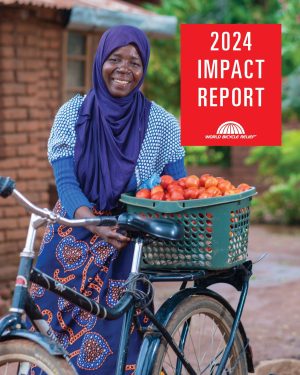

“Sometimes one can die due to lack of transport,” says Siduduzo Gumede, a 53-year-old community health worker in Hwange, Zimbabwe, who wishes all village health workers could have bicycles to help them care for patients.
World Bicycle Relief worked with Greenline Africa starting in 2020 to bring its Mobilized Communities programming to the region by partnering with the community to provide access to more than 2,000 bicycles, mechanics and programming.
Hwange district, situated near Zimbabwe’s largest national park, faces several major challenges, including hot, dry climate with unpredictable weather patterns, lack of access to water and healthcare, extreme poverty, and food insecurity. In the region’s communities, where most of the population falls below the poverty line and rely on subsistence farming to feed themselves and their families, reliable transportation is critical.
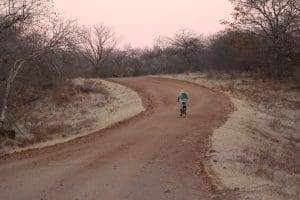
It can take village health workers two days on foot to complete a patient visit, leaving their home early in the morning, arriving midday and then returning home the following day.
Along with a lack of reliable transportation to access healthcare, the community also faces hunger as a result of drought, job loss and a lack of tourists since the start of the Covid-19 pandemic.
“When I was told I was going to receive the bicycle, I was very happy,” says Siduduzo. “I am now able to reach more patients and do more home visits. I visit my patients in time, I come home in time, cook dinner for my boys in time and have time enough to rest.”
 In 2025, we paid another visit to Siduduzo to hear how her life had progressed since we last spoke to her.
Now 57, Siduduzo says her Buffalo Bicycle remains in excellent condition and is her most valued tool.
“I look after it like a member of the family,” she says.
Siduduzo’s role as a community health worker has expanded beyond home visits. She now leads health clubs, conducts sensitization meetings on sanitation and hygiene, and manages care groups. “All these tasks are possible because of my bicycle. It’s more than just transport; it is a tool for efficiency and effectiveness.”
She recalls one moment in particular in which her access to a bicycle played a major role in her work. A woman in the village accidentally cut herself with an axe.
“With no ambulance in sight, I turned the bicycle into an emergency vehicle,” Siduduzo recounts. “I strapped her to the back and rushed her to the clinic. That bike saved a life.”
Beyond her work, Siduduzo is proud of all she’s accomplished with the time saved. She learned how to sew and ventured into poultry farming, which brings in extra income for her family.
“My bike gave me more than just speed,” she says. “It gave me the ability to do more, help more, and grow more. My entire family uses it when I am not on duty. It’s brought us closer together and made life easier for all of us.”
With her story reaching people far beyond her village, Siduduzo is filled with hope. “To know that my story is being seen worldwide inspires me to keep going. I want other women to know that, with the right support, we can do amazing things.”