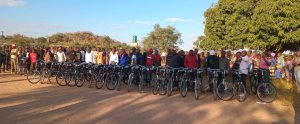
In Zambia’s remote Mumbwa District, the school day often begins long before the bell—on foot, over distance, with many students needing to travel several kilometers on foot to reach school. This term at Chiwena Hope Secondary School, that daily journey changed for good. In September, 129 Buffalo Bicycles were placed with students under our School Ownership Model, part of a broader effort that has brought 234 bicycles to the Chiwena catchment since 2023.
It’s a simple idea with outsized impact: when students can ride, they arrive on time, less tired, and with more time and energy to learn—especially girls who often face the longest, least safe commutes.
This distribution sits in the same district where World Bicycle Relief, together with IDinsight, conducted a landmark randomized controlled trial (RCT) over the past two years. While students were not part of the study, the RCT’s rigorous, causal evidence laid the groundwork for today’s momentum—showing district leaders and national ministries that durable bicycles can drive meaningful, system-wide improvements. That proof helped unlock the willingness of government partners to back a further rollout for students.
The School Ownership Model keeps bicycles as school assets, assigned to learners based on need and distance, and re-assigned over cohorts so the same fleet delivers benefits year after year. A trained Bicycle Supervisory Committee (BSC)—made up of school management and community representatives—oversees fair selection criteria, basic maintenance coordination, and bicycle usage logs. The result is a shared resource that supports attendance, punctuality, study time, and safety for multiple generations of learners. Since 2023, the Chiwena catchment has received 105 bicycles for adults and 129 bicycles for students.
The Mumbwa RCT—with adults in the same communities—tested the causal impact of providing a high-quality, serviceable bicycle. The study’s results gave leaders confidence that bicycles do more than shorten trips; they strengthen households and communities. That is exactly the enabling environment schools need: when families are more secure and services are easier to reach, students are more likely to be in class and ready to learn. The RCT made that case convincingly—opening the door to student-focused investments like Chiwena’s.
The distribution day at Chiwena felt bigger than a ceremony. A distinguished delegation of government officials presided over the event, signaling institutional support for bicycles within education. Local leaders from education, health, and district administration joined school heads, the BSC (Bicycle Supervisory Committee), and the Parent Teacher Committee (PTC) to formally hand over the bicycle fleet. Families and neighbors crowded the school grounds—smiles watching student performances, a sea of uniforms and brand-new bikes—because everyone understood what was at stake: safer commutes, time back in the day, and a clearer path to finishing school. It was a moment of shared pride and shared responsibility, with the BSC and school management stepping forward as stewards of the program.
Buffalo Bicycles are purpose-built for rural terrain and daily load carrying. But hardware is only half the story. The ecosystem—trained mechanics, access to spares, school stewardship, and district partnerships—keeps bicycles rolling. In Chiwena’s catchment, World Bicycle Relief worked alongside the Mumbwa District Health Office, the District Education Board Secretary Office, and the Mumbwa District Department of Community Development & Social Services, aligning mobility across sectors so gains in one area (like health outreach) reinforce gains in another (like school attendance).
Together with the school, we’ll track a meaningful set of success indicators—enrollment, attendance, punctuality, commute time, safety incidents, bicycle usage and maintenance—to guide continuous improvement. As the district and national partners look ahead, Chiwena Secondary School in Mumbwa offers a clear template: evidence-backed, school-managed mobility that’s practical to scale.