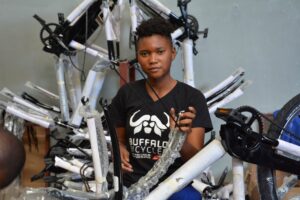
In 2025, World Bicycle Relief (WBR) marked a significant milestone in Petauke District, Zambia, deepening its commitment to transforming rural communities through the Power of Bicycles. Building on the foundation laid in 2024, World Bicycle Relief collaborated closely with the Petauke District Education Board Secretary (DEBS) and the District Community Development and Social services department to deliver 500 Buffalo Bicycles to community members in need. This effort is part of World Bicycle Relief’s innovative Mobilized Communities model — a holistic, multi-sector approach designed to create sustainable, community-owned mobility ecosystems.
The 500 bicycles distributed this year were allocated with a strategic focus on sectors that deliver the greatest potential for positive change:
Central to the success in Petauke is the Mobilized Communities model — an integrated, community-powered approach that goes far beyond bicycle distribution. Each Mobilized Community begins with an in-depth Mobility Needs Assessment, where community members and local leaders identify the most pressing mobility barriers and design solutions together. Local Bicycle Supervisory Committees (BSCs) then oversee the fair allocation of bicycles, prioritize women and girls, and guide participant selection based on distances traveled and potential impact.
Participants enter into service-to-own agreements, ensuring bicycles are used for their intended purpose and become a lasting community asset. In parallel, World Bicycle Relief trains local mechanics to maintain and repair bicycles, supported by a network of spare parts and retail outlets through Buffalo Bicycles Ltd. This model strengthens community capacity, fosters local leadership, and builds a sustainable mobility ecosystem that empowers individuals to create and sustain change together.
For Amos, a 58-year-old lead farmer in Kaombwe, the Mobilized Communities program has been life-changing. Before receiving his Buffalo Bicycle in August 2022, Amos regularly walked up to 30 kilometers, three times a week, to transport his garden produce to the market — a six-hour journey each way.
“I used to struggle to hire other people’s bicycles to transport my produce, and they would charge me K50 per trip,” Amos recalls. “Having my own bicycle is really life changing as I am now able to save the little money I used to pay to others and invest more into my gardening and farming.”
With his Buffalo Bicycle, that same trip now takes just four hours. Amos uses the bicycle daily to carry vegetables and other produce to the market and has joined the Chasika Savings group, where he now saves K500 each month. “I am able to make many trips to the market, make more profit and savings, and provide for my family with food, clothing, and other needs,” he shares.
Beyond farming, the bicycle has become a critical tool for his household and community. “I sometimes use the bicycle to take a family member to the clinic, attend funerals, or carry maize to the hammer mill. My favorite thing about the Buffalo is the back carrier — it’s so strong and allows me to carry heavy loads to the market without difficulty.”
For Amos, the impact isn’t just measured in kilometers saved or profits earned. “I now have enough time to spend in my farming and gardening activities as well as attending to my family needs and spending quality time with them at home,” he says with pride. “The bicycle is very strong and durable, and it has truly helped with my movement. I would love WBR to help more people in my community who are still struggling with mobility challenges.”
The bicycle is very strong and durable, and it has truly helped with my movement.
The anticipated outcomes for Petauke’s Mobilized Community reflect both immediate improvements and long-term transformational change. In the short term, students — especially girls — are expected to experience improved school attendance and reduced tardiness, while households gain better access to healthcare, markets, and community services. Over time, these gains are projected to result in increased household income, greater income diversity, higher savings rates, and enhanced access to essential health services.
Critically, the community anticipates a measurable increase in the percentage of girls and boys who remain enrolled in school, contributing to long-term educational success and reducing the risks of early marriage and poverty. Strengthening internal locus of control among program participants is also a key goal, helping individuals feel more empowered to shape their futures.
The success of 2025 builds on insights and groundwork from the Mobilized Communities program launched in 2024. That year, we worked closely with community leaders, government partners, and BSCs to conduct a comprehensive Mobility Needs Assessment (MNA). Findings highlighted the critical role of affordable and reliable transportation in overcoming barriers to education, healthcare, and economic opportunity in Petauke — a district where 70% of the population lives in poverty and where rural residents often walk long distances to reach basic services.
The 2024 foundation also emphasized community ownership through strengthening of existing structures such as the Parent Teacher Committees (PTCs), the formation of BSCs and capacity building, setting the stage for continuous monitoring, adaptation, and learning. This participatory model ensures that the community itself drives and sustains change.
With a goal of distributing approximately 14,500 bicycles in Petauke by 2026, World Bicycle Relief’s momentum in 2025 exemplifies how targeted, community-driven mobility interventions can transform entire districts. Each Buffalo Bicycle represents more than a mode of transport; it is a vehicle for education, economic empowerment, and social resilience — especially for women and girls.
Through continued collaboration with local partners and the ongoing strengthening of the bicycle ecosystem, Petauke is steadily moving toward becoming a thriving, self-sustaining Mobilized Community. Our commitment to listening, learning, and evolving alongside the community remains central to this journey, inspiring a future where every resident has the freedom to pursue opportunity, build resilience, and thrive.