Twenty years ago, we watched in shock from afar as the tragic Indian Ocean tsunami devastated entire communities across Southeast Asia.
As a co-founder of bicycle components manufacturer SRAM, F.K. Day had spent his career in the bicycle industry. Leah Missbach Day, a documentary photographer, had dedicated herself to capturing human stories.
We knew immediately that we wanted to help. Initially, we considered raising funds but quickly realized we had the opportunity to do something more—something uniquely powerful.
Together, we wondered, what if we could leverage our experience and connections to provide something critical to help people rebuild?
F.K. had the industry connections to source bicycles, and, as a documentary photographer, Leah could capture and communicate the urgency of the crisis.
To affirm our hunch, we needed to see the disaster’s aftermath – and its impact on the community – firsthand. So, we flew to Indonesia and Sri Lanka, where we met with local communities and aid organizations to hear directly from them how we could meet their needs.
With support from SRAM and other leaders in the bicycle industry, we carefully chose World Vision as our implementing partner and discovered Lumala Bicycles, a local manufacturer that would simplify sourcing. Our team coordinated warehousing and distributions of bicycles while trusting World Vision’s deep local knowledge to identify recipients. Their meticulous record-keeping made them the right partner—because if you don’t measure it, you can’t fix it. That belief has guided us since day one.
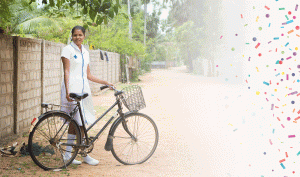
With that, World Bicycle Relief was born, distributing more than 24,000 bicycles in Sri Lanka in 2005.
If you don’t measure it, you can’t fix it.
What we didn’t realize at the time was that bicycles didn’t just help communities recover—they were unlocking long-term opportunity.
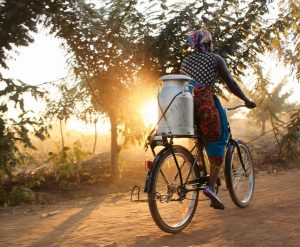
After that initial distribution in Sri Lanka, we asked ourselves where else could bicycles change lives. That led us to Zambia, where healthcare workers were walking hours to reach their patients, students were struggling to attend school, and families had limited access to markets and jobs.
As in Sri Lanka, we first looked to local bike suppliers and tested them in the communities. Unfortunately, we found that they began to fail almost immediately. Bicycles were available, but not durable because they weren’t designed for the rugged terrain and unpaved roads. When a bike inevitably broke down, spare parts were difficult to source.
The situation called for a more durable bicycle, built for rugged terrain and heavy loads. Inspiring us to work with industry partners to design, test, and develop the first of several Buffalo Bicycle iterations— tough, purpose-built bikes engineered for the demands of rural life.
With the help of future CEO Dave Neiswander, we mapped out a vision – and a unique business model that would help us get more bikes into the hands of those who needed them most.
The results were astounding and confirmed what we thought to be true: With the right tool, individuals could create their own solutions.
The model worked.
Today, 20 years later, and with many thanks for your inspirational support, we’ve distributed more than 868,000 bicycles across 21 countries and collected data to prove our effectiveness.
As we mark this milestone year, we look back with pride and gratitude, because when we know where we have come from, we know where we are going—and nothing can stop us.