New Report Shows Big Results
The event featured the launch of World Bicycle Relief’s latest research report:
Accelerating Health Access: The Impact of Buffalo Bicycles on Community Health Work.
The report focuses on CHEWs in Lira and Mayuge districts who received Buffalo Bicycles through World Bicycle Relief/Buffalo Bicycle Uganda’s partnership with the Ministry of Health. The results are compelling:
- CHEWs doubled the number of households they visit.
- Travel time was cut in half, giving them more time for patient care.
- The quality of care improved, with CHEWs reporting less fatigue, more consistent visits, and stronger trust from the communities they serve.
As World Bicycle Relief and Buffalo Bicycles’ Regional Director for East Africa, Maureen Kolenyo shared, “When we give health workers reliable transportation, we’re not just making their jobs easier—we’re helping entire communities access the care they deserve.”
This report builds on findings from a 2023 randomized controlled trial in Zambia, which showed that bicycles led to increases in income, productivity and access to services—especially for women and health workers.
Powerful Voices, Personal Stories
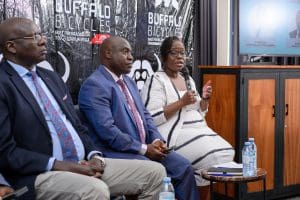
The forum featured a dynamic lineup of speakers who brought diverse perspectives to the table. Dr. Diana Atwine, Permanent Secretary of Uganda’s Ministry of Health, delivered the keynote address and emphasized the Ministry’s commitment to expanding access to bicycles through national health programs. Dr. Richard Kabanda, Commissioner for Health Promotion, underscored how mobility solutions like bicycles align with Uganda’s broader public health strategy.
Representing the Development Partner sector, Dr. Michael Etukoit, Executive Director of TASO, and Henry Magala, Country Director at AIDS Healthcare Foundation, spoke about the logistical challenges their organizations face—and how bicycles could help health workers reach more patients in less time.
Anne-Marie Bewulira Wandera, a respected media personality and independent financial advisor, moderated one of the panel discussions, bringing warmth and insight to the conversation. Kolenyo shared key takeaways from the new report. Meanwhile, CHEWs offered first hand stories of how Buffalo Bicycles are changing their work and the lives of the people they serve.
Bonny, a Community Health Extension Worker from Lira District and a participant in the study, shared a powerful personal story during the forum. Before receiving a Buffalo Bicycle, Bonny would spend hours walking from village to village, often arriving too exhausted to provide the level of care her patients needed.
“By the time I got to a household, I was tired. Sometimes I had to choose which families I could realistically reach that day,” she said. “It was frustrating to know people needed me, but I couldn’t always get there in time.”
Since receiving her bicycle, everything has changed. “Now I visit more households every day. I get there faster, and I still have the energy to listen, to treat, to educate,” she explained. “I feel proud of the work I’m doing because I can actually show up when people need me. The bicycle has made me a better health worker—and my community is healthier because of it.”