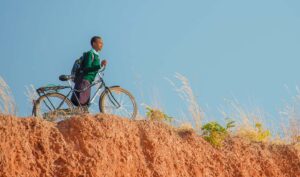
Saida: Reaching for her future

Across the globe, millions of girls carry hopes of continuing their education, building a future, and making their families proud.

But too often, they’re missing a key to making it all possible: a way to get there.

Meet Saida

We met Saida, a 14-year-old student in the seaside town of Bagamoyo, Tanzania, in February 2026. 

Just nine months earlier, she had received one of the 50 Buffalo Bicycles distributed to students who traveled long distances each day. And today, 50 more of her peers would have that same opportunity.
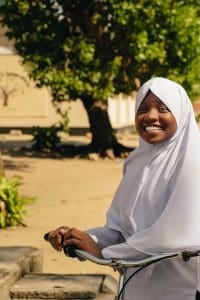
Her smile is easy, bright. Saida speaks with quiet confidence about her future: One day, she wants to become a doctor – a neurosurgeon. In a country that faces a strained healthcare system, Saida says she’s seen too many people suffer from inadequate care. She wants to be part of the solution.

Not so long ago, that future felt out of reach.

Before receiving the bicycle, Saida’s day began with a 90-minute walk to school, knowing she wouldn’t arrive in time to help with school duties or even her first class. Her grades were “satisfactory,” falling short of what she needed to pursue her dreams.

The journey itself also came with risks. Like many girls, she faced harassment on the road, making each trip not just long, but unsafe.

“Before the bicycles arrived, parents had to spend between 2,000 and 3,000 Tanzanian shillings per day to bring their children to school,” says Emanuel, a teacher and member of the local bicycle supervisory committee. “Some parents could not afford this, so their children had to walk.”
World Bicycle Relief’s ecosystem

Saida’s story is not unique. It’s the reality for millions of girl students across rural communities – where distance, cost, and safety form a system of barriers that keep girls out of school.

And that’s exactly what World Bicycle Relief’s bicycle ecosystem has been designed to address.

A bicycle alone isn’t the solution. It’s the entry point to something bigger.

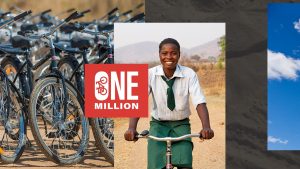
Through a locally led model, Buffalo Bicycles are distributed alongside training for community-based mechanics, the establishment of spare parts supply chains, and school-led supervisory committees that ensure the bicycles are used, maintained and prioritized for those who need them most. The result: access, reliability, accountability and long-term mobility.

In Bagamoyo, that system is already at work. The same committee Emanuel serves on helps identify students like Saida, supports their use of the bicycles, and ensures they remain in working condition – so the impact doesn’t fade after distribution day.

A brighter future

Saida can attest to that impact.

She now arrives at school on time. Her grades have improved significantly, and even her friends and family have noticed a change in her. Just as importantly, Saida feels safer.

“Now, I can take the main road and go straight home. They can’t bother me anymore.”

For Saida, a bicycle didn’t just shorten the distance to school. It brought her closer to her future.

And while the road ahead isn’t easy, Saida is clear about where she’s headed.

“Through this opportunity, I believe I will be able to achieve my dream of becoming a great doctor,” she says. “And one day I hope to go to work in India.”

Saida’s story is just one – but it reflects what’s possible when barriers are addressed at every level, and when mobility is seen as essential infrastructure.

Because when girls can reliably get to school, they don’t just dream about the future. They can begin to build it.


Ready to help more girls pedal the path toward their dreams?
Donate today

More Stories Like This One