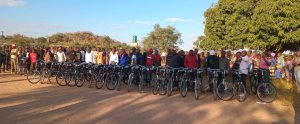
Nearly ten years ago, a transformative initiative rolled into the remote communities of Solwezi, Zambia: the Solwezi Bicycles for Educational Empowerment Program (BEEP). Launched in 2015, this program, in partnership with World Vision and made possible by the generous funding from ZF hilft e.V. as part of their visionary “100 Years – 100 Schools” campaign, set out to address one of the most significant barriers to education in rural Zambia—distance. With 1,700 Buffalo Bicycles distributed across 12 schools, the goal was simple yet powerful: make it easier for students to get to school, stay in school, and succeed in their education.
Now, almost a decade later, we’re asking an important question—what has changed? How do we evaluate the long-term impact of such a development-focused program? In early 2024, World Bicycle Relief returned to Solwezi to assess the program’s legacy, measuring not just how well the bicycles have held up but also how they’ve been woven into the fabric of community life. What we found speaks volumes about the enduring power of these robust machines.
When we first launched the BEEP program, the focus was on giving students a reliable way to get to school. For children who walked hours each day just to attend class, a bicycle was more than just a convenience—it was a lifeline. But what has become of those bicycles after nearly ten years of use? Are they still in service? Have they lived up to the promise of increasing access to education?
In our 2024 assessment, we revisited three schools that were part of the original program. We were heartened to see that out of the 243 bicycles given to students in grades 1-3 at these schools, 39% are still in use, nearly ten years later. Out of this original distribution, 24 bicycles have been passed down to younger siblings or neighbors, ensuring that they continue to meet educational needs long after their original recipients graduated. The sight of these well-worn bikes, still rolling through the dirt roads of Kalumbila, speaks to the lasting value of the program.
For students like Grace, who received her Buffalo Bicycle as a second grader, the impact has been life-changing. In 2015, Grace was walking 1.5 hours each way to Kisasa Secondary School. The long commute meant she was often late and too tired to focus on her studies. But when Grace was given a bicycle, her world opened up. Her travel time dropped to just 30 minutes, and she was able to arrive at school on time and ready to learn. Fast forward to 2024, and Grace is on track to finish secondary school, with dreams of becoming a geologist—a dream she says would not have been possible without the BEEP program.
Grace’s story is not an outlier. In nearly every school we revisited, students and their families credited bicycles with improving their ability to attend school regularly. The program didn’t just help students academically; it also changed the way they and their families navigated daily life.
The community impact of the BEEP program extends far beyond education. For families in rural Zambia, a bicycle is a critical asset that helps with much more than school commutes. It becomes a tool for survival—used to fetch water, transport goods, and even take sick family members to health clinics.
Take Miriam for example. Her older sister, Janet, received a bicycle in 2015 and used it for seven years to finish secondary school. Now, Janet has passed that same bicycle down to Miriam, ensuring that it continues to serve the family’s needs. Beyond getting to school, the bicycle is used to carry water from a distant borehole and transport goods to the market. What started as a tool to improve education has become a vital part of the household’s daily life.
Of course, no long-term program is without its challenges. Our assessment also revealed the difficulties communities face in maintaining the bicycles after so many years of use. Saddles wear out, tires puncture, and chains need replacing. Spare parts for Buffalo Bicycles can be hard to come by in remote areas, which has led many families to substitute non-Buffalo parts to keep their bicycles in working order. Despite these adaptations, the fact that so many bicycles are still in use is a testament to both the durability of the bikes and the resourcefulness of the communities.
Local mechanics, like Fredy, have played an essential role in keeping these bicycles on the road. Trained by World Bicycle Relief, Fredy repairs about 20 to 25 bicycles each month. His work has not only provided a steady income for his family but also helped ensure that these bicycles continue to serve the community. Fredy’s biggest challenge? Access to reliable spare parts. Despite this, his dedication to his work has kept dozens of bicycles functional, prolonging their impact far beyond what was originally anticipated.
Perhaps the most significant insight from our return to Solwezi was how the program’s benefits have extended well beyond education. We’ve seen firsthand how the bicycles have reduced early marriages and pregnancies. Increased school attendance has kept more girls in the classroom, delaying marriage and reducing the risks associated with dropping out. This ripple effect is profound. By staying in school longer, girls are better positioned to make informed decisions about their futures.
The program has also changed the way communities view education. Parents who once hesitated to send their daughters to school now see the value of education, especially when a bicycle makes the journey safer and quicker. Teachers like Mr. Elias Mumba, headteacher at Chovwe Secondary School, have seen a remarkable shift in school culture, particularly among female students. “Since the bicycles were distributed, we’ve seen a significant reduction in early marriages and pregnancies among our students,” he notes.
Evaluating a development program nearly ten years after its inception offers unique insights into what works, what doesn’t, and how to build for the future. The BEEP program has shown us the power of bicycles to transform lives—not just for a few years but for an entire decade and likely beyond.
To build on these lessons, World Bicycle Relief’s new strategy centers around a comprehensive bicycle ecosystem model designed to create lasting, scalable impact. This approach extends beyond distributing bicycles; it encompasses training local mechanics, ensuring access to spare parts, and fostering local supply chains through Buffalo Bicycle shops. The Solwezi BEEP program exemplifies how a sustainable ecosystem can amplify the long-term benefits of mobility solutions, offering a blueprint for resilient community development and unlocking new pathways to education, healthcare, and economic empowerment in the communities we serve.
The Solwezi BEEP showcases sustainable development and reminds us that the true measure of success in development work isn’t just immediate results but the lasting, positive change that continues to grow long after the program’s official end. Ten years later, these Buffalo Bicycles are still making a difference in the lives of students, families, and entire communities in Zambia. And that’s something worth celebrating.