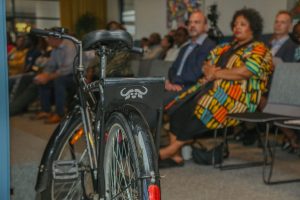

At World Bicycle Relief, we believe in data-driven solutions to address mobility poverty and its profound impact on economic opportunity, healthcare access, and social empowerment. Building on our randomized controlled trial (RCT) conducted with IDInsight in Mumbwa, Zambia, we launched a Bicycle Tracking Project to deepen our understanding of how Buffalo Bicycles are used in rural communities. Through this study, we collected data from GPS devices, travel diaries, and household surveys, offering valuable insights into the frequency, purpose, and intensity of bicycle usage. The findings reaffirm the bicycle’s role as a powerful, adaptable tool that helps families and communities overcome mobility barriers.
The tracking project set out to answer five key questions: How far do Buffalo Bicycles travel? How much time is spent traveling? What are the variations in usage by gender and sector? What are the most common travel destinations? And finally, who are the primary and secondary users within households? We attached GPS devices to 35 Buffalo Bicycles across the community and supplemented this data with self-reported travel diaries and household surveys from our RCT participants.
This multifaceted approach offered a holistic view of bicycle usage, revealing high levels of usage and intensive travel patterns. These insights highlight the pivotal role of bicycles as last-mile mobility solutions, empowering people to access markets, healthcare, and essential services that would otherwise be out of reach.
The tracking project also confirmed bicycles’ role in expanding healthcare access. The data shows that health volunteers traveled an average of 15 kilometers and 1.6 hours per day to provide health services to their communities. Nearly 90% of bicycle recipients used their bikes to visit health facilities. Community health volunteers, who used their bicycles to serve 63% more households, also employed the bicycles as makeshift ambulances, averaging 15 trips over 11 months—approximately twice per month. The bicycles’ utility for healthcare delivery is a testament to their adaptability, further reinforcing their role as essential tools for last-mile mobility.
The tracking data aligns with our RCT findings, which showed that households with bicycles improved their productivity and maintained stable levels of consumption and income even during Zambia’s severe drought. The bicycles allowed families to access resources and income opportunities, highlighting the resilience-building power of mobility in the face of environmental challenges.
The Bicycle Tracking Project in Mumbwa provides invaluable insights into how bicycles are transforming lives in rural Zambia. By combining rigorous data collection with the lived experiences of our program participants, we are deepening our understanding of how mobility impacts rural development. These findings will inform our future programs, ensuring that every Buffalo Bicycle distributed continues to empower individuals and uplift communities.
Visit https://worldbicyclerelief.org/idinsight/ to read the full tracking project report, where we delve even deeper into the quantitative and qualitative insights that this project has brought to light. Through these data-driven efforts, we reaffirm our commitment to addressing mobility poverty and enhancing resilience in underserved communities.