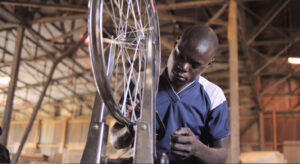

Princely joined World Bicycle Relief full time in 2010, after doing contract work for our Zimbabwe office. He started his journey in the assembly facility and worked his way up the ranks to Bicycle Monitor and Mechanic Trainer, responsible for program training and quality control, then Product Specialist. Today, Princely’s role has again grown to Regional Product Officer, working across Southern Africa to support the product development team, our assembly facilities and test riders.
“World Bicycle Relief has given me opportunities and trust. I look at where I come from, to what I have achieved … I just keep focusing and pushing forward, trying new things and learning from all the experiences.”
As a Regional Product Officer, Princely plays a key role on the product development team in ensuring the quality of the Buffalo Bicycle. From his role in Zimbabwe, he helps collect information from the ground, tests new products, supports test riders and works with the assembly teams on quality control.
Princely’s work also included testing and refining the latest Buffalo One and Pro models. He finds it particularly interesting to hear the test riders’ comments as “field testing” shows you exactly the sort of challenges the bike will face when in use everyday.
“We have to try to dig deeper to get the information they need and build the best product,” he says.
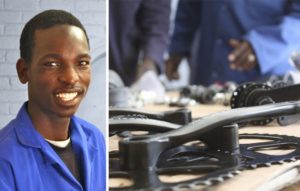 For many years, Princely led World Bicycle Relief’s mechanics’ training program in Zimbabwe and loved working with the mechanics.
The training program is an essential part of our self-sustaining model. Once Buffalo Bicycles are available in a community, riders rarely need to leave for repair or maintenance, and local residents interested in becoming mechanics can create a new income stream.
“If you want a good bicycle, you must know how to assemble it properly,” Princely says. “If you can’t build a bicycle from the ground up,” Princely says, “you won’t get near a Buffalo Bicycle in the field as a mechanic.”
Trainees at the Harare, Zimbabwe, facility receive four days of training on-site, followed by a fifth day when they are put to the test and must build their own Buffalo Bicycle from the ground up. Participants also learn techniques and tricks of the trade from seasoned assemblers.
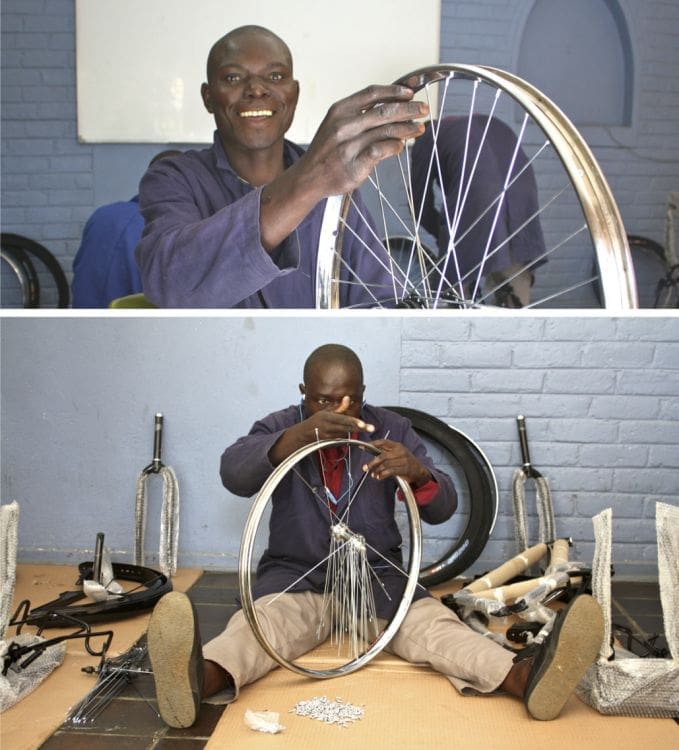
They are given hand tools and assemble the bike without power tools or benches in the assembly facility. The workshop simulates real-world conditions where some mechanics will set up their shops with little more than a cardboard mat under a tree.
Replicating these conditions gives a much better chance of succeeding in the communities where they work. At the end of the day, each trainee has successfully built a Buffalo Bicycle and gives his or her bike a test ride.
Trained mechanics receive a uniform, tools, a bike repair manual, and basic business and marketing training. On average, each mechanic trained in Harare has a built-in market of at least 100 Buffalo Bicycles to service in their area, thanks to education programming at area schools and health clinics.
Princely’s story is also motivating to the mechanics he helped train in that role. Since then, many have become shop controllers and credit Princely with the knowledge they gained under his watchful eye.
Despite his success, Princely remains humble.
“I never dreamed to be where I am today,” he says. “The first day I started here, I didn’t see myself being where I am today. I would see myself growing. I don’t limit myself. I am keeping room to grow.”