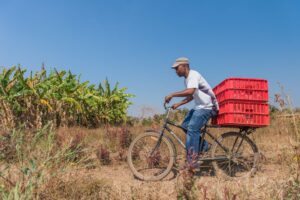
Jackton, a businessman in Kenya, became one of World Bicycle Relief’s test riders in Kisumu in 2010. But his testing doesn’t happen in a lab or on a closed course. It happens as he goes about his work, traveling from shop to shop and carrying bread to customers across roads that are often difficult to navigate.
“What I’m doing, and I’ve done it for so many years, is supplying bread,” Jackton said. “The shops are not in one particular place; they are in various places. These roads are not in good condition. When I use a Buffalo Bicycle, the bicycle is helping me because I can penetrate through these bad roads.”
As a test rider, for World Bicycle Relief’s product development team, Jackton provides feedback based on how the bicycle performs during the demands of his daily life.
Reliability is the name of the game for Jackton. The bread must reach shops in time for customers to buy it during the busiest hours at the market. A breakdown or delay can mean lost sales—not only for Jackton, but also for the shop owners who depend on his deliveries.
Before owning a Buffalo Bicycle, Jackton used an “ordinary” bicycle that frequently broke down and became stuck in the mud. The Buffalo gave him a stronger, more reliable way to travel his routes.
“This bicycle is durable. This bicycle is strong,” he said. “I don’t use a lot of force.”
His experience gives the product development team insight into how a bicycle holds up over years of regular use—and where it can continue to improve.
The product development team doesn’t evolve the Buffalo Bicycle through engineering alone. Their process begins with the experiences of the people who ride, maintain and depend on these bicycles every day.
Feedback from riders like Jackton helps the team understand how each bicycle performs over time and under real-world conditions—from rough roads and heavy loads to long hours in the saddle. Their experiences reveal what is working, where riders face challenges and what could make the bicycle more comfortable, reliable and easier to use.
Those insights guide continued testing and refinement. Over time, they have helped shape improvements across the Buffalo Bicycle, ensuring that its evolution remains grounded in what riders need from a dependable tool for the job.
Jackton has continued testing Buffalo Bicycles as the design has evolved. By riding different versions in real working conditions, he can compare how changes affect comfort, effort and performance over time.
When World Bicycle Relief checked in with him in July 2025, he reflected on the improvements he had experienced.
“The bicycles I started using are still running and operational,” he said. “At first, there were bicycles that required a lot of energy, but as time has gone by, the improvements have made them more comfortable to use. The newer models don’t require as much effort, so I can work for longer hours each day without getting tired.”
That kind of long-term perspective is valuable. Jackton doesn’t simply test a bicycle for a few days and report back. He sees how it performs across changing road conditions, demanding delivery schedules and years of continued use.
Jackton has since purchased four additional Buffalo Bicycles, which he uses across several businesses, including his bread-selling operation.
As the bicycles have improved, he says his business has grown with them.
“I’ve managed to expand my business because the bicycles have enabled me to reach more customers, which has tremendously increased my revenue,” he said. “I can now reach more people.”
For Jackton, testing a bicycle is inseparable from using it as a tool for his livelihood. Every trip offers another opportunity to understand what works, what lasts and what could work even better.
That feedback helps World Bicycle Relief continue building bicycles for the realities its riders face every day.
“A businessman is expected to plan for the future,” Jackton said. “You plan for your own future. You plan for the future of your family. I’m doing it just because of this bicycle.”